
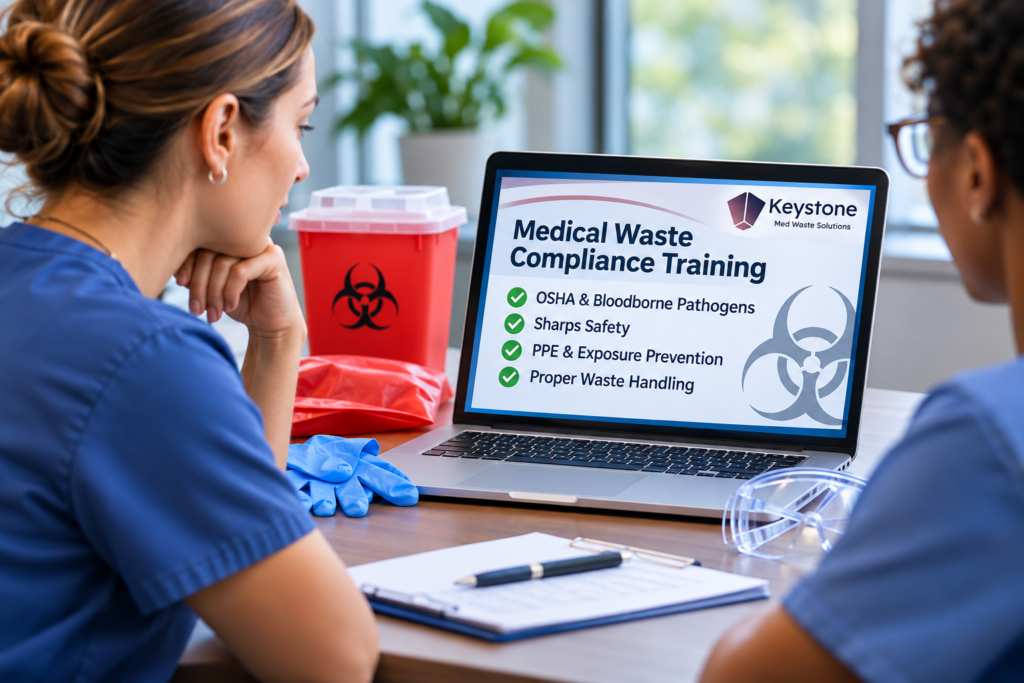
Medical waste compliance training helps healthcare teams protect employees, prevent exposure risks, and promote safer workplaces.
Medical waste compliance training is about more than checking a box. It’s about protecting employees, preventing injuries, and creating a safer workplace.
Healthcare organizations handle potentially hazardous materials every day. From used needles and contaminated supplies to bloodborne pathogens and pharmaceutical waste, proper handling requires knowledge, training, and established safety procedures.
However, OSHA compliance isn’t limited to hospitals and large healthcare systems. Many smaller practices, dental offices, laboratories, and other businesses must also follow workplace safety requirements.
Understanding which regulations apply to your facility is an important first step toward protecting your team and maintaining compliance.
What Does OSHA Require for Medical Waste Compliance?
The Occupational Safety and Health Administration (OSHA) establishes and enforces workplace safety standards designed to protect employees from occupational hazards.
When it comes to medical waste, OSHA focuses primarily on protecting workers from exposure to blood, other potentially infectious materials, hazardous substances, and related workplace risks.
Its requirements may affect how organizations:
Handle and segregate regulated medical waste
Use and dispose of contaminated sharps
Select and provide personal protective equipment (PPE)
Develop workplace exposure control procedures
Train employees on occupational hazards
Respond to exposure incidents
Maintain required training and safety documentation
Importantly, OSHA does not regulate every aspect of medical waste disposal. State and local agencies establish many disposal requirements, while other federal regulations may apply to transportation, hazardous waste, and pharmaceutical waste.
Therefore, healthcare organizations need to understand how these different requirements work together.
Understanding OSHA’s Bloodborne Pathogens Standard
One of the most important regulations affecting medical waste handling is OSHA’s Bloodborne Pathogens Standard (29 CFR 1910.1030).
This standard applies to employers with employees who can reasonably anticipate occupational exposure to blood or other potentially infectious materials (OPIM).
Its purpose is to reduce the risk of workplace exposure to bloodborne pathogens, including hepatitis B, hepatitis C, and HIV.
1. Written Exposure Control Plans
Covered employers must establish a written Exposure Control Plan that identifies occupational exposure risks and explains how the organization will reduce them.
The plan must address applicable protective measures, employee responsibilities, and procedures for responding to exposure incidents.
Employers must review and update the plan at least annually and whenever necessary to reflect changes in workplace procedures or exposure risks.
2. Universal Precautions and Protective Equipment
Under OSHA’s universal precautions approach, employers and employees must treat human blood and specified body fluids as potentially infectious.
Organizations must implement appropriate engineering and work practice controls to minimize exposure.
When occupational exposure remains possible, employers must provide suitable PPE, such as gloves, protective clothing, masks, or eye protection, based on the hazards involved.
Additionally, employees need training on when protective equipment is necessary, how to use it correctly, and how to remove and dispose of contaminated items safely.
3. Exposure Incident Procedures
Even with appropriate precautions, workplace exposure incidents can occur.
Employers covered by the standard must establish procedures for reporting and evaluating incidents involving blood or OPIM.
Following an exposure incident, employers must make confidential medical evaluation and follow-up available in accordance with OSHA requirements.
Clear reporting procedures and employee training help organizations respond appropriately when incidents occur.
4. Employee Training and Documentation
OSHA requires employers to provide bloodborne pathogens training to employees with occupational exposure.
Training must occur:
At the time of initial assignment to tasks involving occupational exposure
At least annually thereafter
When changes in tasks or procedures create new occupational exposure risks
Training must be provided at no cost to covered employees and during working hours.
Furthermore, employers must maintain required training records and ensure that employees can ask questions and receive answers from a knowledgeable individual.
Sharps Safety: A Critical Component of OSHA Compliance
Used needles, lancets, and other contaminated sharps create significant workplace hazards.
Improper handling or disposal can expose employees to needlestick injuries and potentially infectious materials.
OSHA establishes specific requirements for contaminated sharps containers. They must be:
Closable
Puncture-resistant
Leakproof on the sides and bottom
Properly labeled or color-coded
Accessible and located appropriately for their intended use
Employers must also ensure containers are maintained upright during use and replaced routinely rather than allowed to overfill.
Additionally, OSHA generally prohibits bending, recapping, or removing contaminated needles unless a specific exception applies. When an exception is permitted, appropriate safety procedures must be followed.
Some employers must also maintain sharps injury logs under OSHA’s recordkeeping requirements.
For more information, read our guide to sharps container regulations and safe disposal practices.
Which Healthcare Facilities Need OSHA Compliance Training?
OSHA’s workplace safety standards extend beyond traditional hospitals and medical practices.
Depending on employee duties and occupational exposure risks, bloodborne pathogens training and other safety requirements may apply to organizations such as:
Hospitals and outpatient clinics
Dental and specialty practices
Medical laboratories
Home healthcare and hospice providers
Medspas and aesthetic clinics
Long-term care facilities
Emergency medical services
Funeral homes and mortuary services
Tattoo and body piercing establishments
Veterinary facilities, where applicable workplace hazards and standards warrant specific protections
The determining factor is not simply the type of facility. It is the nature of the work and the hazards employees may encounter.
For example, a small medical practice with employees who routinely handle contaminated sharps may have significant OSHA training responsibilities despite generating relatively little medical waste.
Conversely, not every employee within a healthcare organization necessarily has the same training requirements.
Employers should evaluate job responsibilities and occupational exposure risks when determining which training obligations apply.
Other OSHA Standards That May Affect Medical Waste Handling
Although the Bloodborne Pathogens Standard is central to many medical waste safety programs, additional OSHA requirements may apply.
| OSHA Standard | Relevance to Healthcare Facilities |
|---|---|
| Bloodborne Pathogens — 29 CFR 1910.1030 | Exposure prevention, contaminated sharps, regulated waste handling, and employee training |
| Hazard Communication — 29 CFR 1910.1200 | Communication and training concerning hazardous chemicals in the workplace |
| Personal Protective Equipment — 29 CFR 1910 Subpart I | Hazard assessments, appropriate PPE, and employee protection |
| Sanitation — 29 CFR 1910.141 | Workplace sanitation and housekeeping requirements |
Organizations should also consider applicable state OSHA plans and other federal, state, and local regulations.
Five Ways to Strengthen Your Medical Waste Compliance Training Program
An effective training program should do more than meet minimum requirements. It should help employees recognize hazards and make safer decisions during everyday operations.
1. Evaluate Employee Exposure Risks
Identify which employees handle sharps, regulated medical waste, blood, or other potentially infectious materials.
Use these findings to determine applicable training and protective measures.
2. Establish Consistent Waste Handling Procedures
Develop clear procedures for waste segregation, sharps disposal, container management, and exposure prevention.
Ensure employees understand these procedures and have access to appropriate equipment.
3. Keep Training Current
Schedule required initial and annual training, and provide additional instruction when workplace procedures or exposure risks change.
Don’t assume previous training remains sufficient indefinitely.
4. Maintain Organized Documentation
Keep required training records, exposure control plans, and other applicable safety documentation organized and accessible.
Proper documentation helps demonstrate that an organization has established and maintained its safety program.
5. Work With a Knowledgeable Compliance Partner
Medical waste management involves multiple regulations, operational considerations, and employee safety responsibilities.
A knowledgeable partner can help organizations access training resources, identify practical improvements, and support consistent waste management procedures.
Make Compliance Training Easier With Keystone Med Waste Solutions
At Keystone Med Waste Solutions, we believe compliance training should be accessible, practical, and easy to manage.
That’s why we offer convenient online compliance training resources through our Client Portal, helping healthcare organizations support employee education and maintain organized training records.
Keystone customers receive 10 complimentary training credits per clinic annually — a $250 value. Additional training credits are available for $25 each.
Our training resources cover important healthcare workplace topics, including OSHA-related safety, bloodborne pathogens, HIPAA, and DOT-related training.
Combined with our medical waste collection and disposal services, responsive customer support, and transparent pricing, these resources help healthcare organizations simplify their waste management programs.
Because effective compliance isn’t simply about avoiding violations. It’s about protecting the people who provide care, the patients they serve, and the communities around them.
Elite Service. Expert Compliance. Competitive Value.
Contact Keystone Med Waste Solutions to learn more about our medical waste management services and available compliance training resources.
This material is provided for general informational purposes only and does not constitute legal, regulatory, or compliance advice.
Compliance requirements for medical and hazardous waste management vary by jurisdiction and are subject to change.
Each facility is responsible for independently verifying and complying with all applicable laws and regulations.
Keystone Med Waste Solutions assumes no liability for reliance on this information.