
OSHA reports that healthcare is one of the most hazardous industries – even more than construction.
If your waste handling is noncompliant, your facility is contributing to that statistic.
Work-related deaths, injuries, and other health-related hazards are frighteningly diverse. They’re also unnecessarily common. Most facility leadership thinks about medical waste mishandling in terms of fines and audits. Those penalties are severe, make no mistake, but OSHA acknowledges that hospitals report twice as many work-related injuries and illnesses than private industry. That’s even more than the construction industry.
Medical waste health hazards like improper sharps storage, mishandled pharmaceuticals, and incorrectly sorted biohazardous waste can go from oops accident to call-an-ambulance accident in an instant.
Most Common Medical Waste Health Hazards on the Job
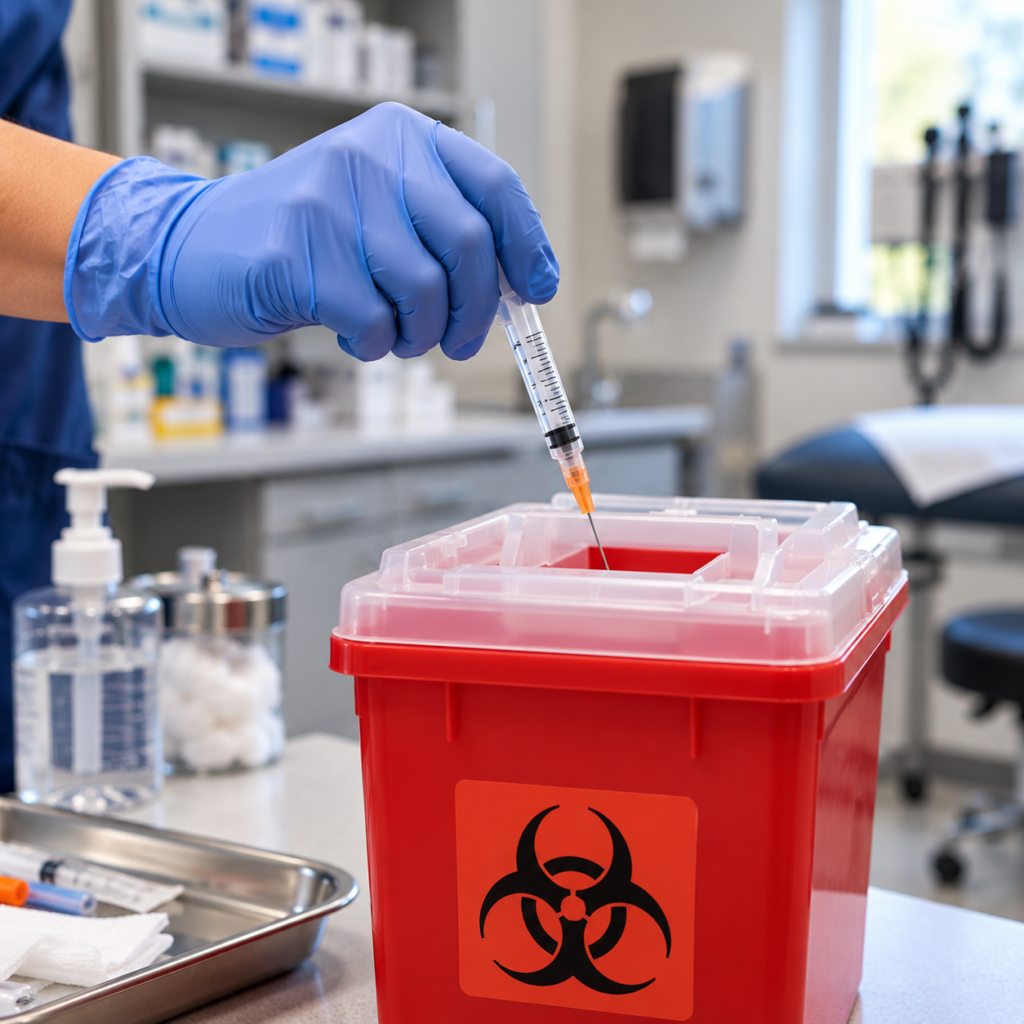
The CDC counts 385,000 needlesticks and sharps injuries to healthcare employees every year. That’s a staggering number of injuries that can range from a little scrape to a death sentence, and sometimes it’s impossible to tell which is which. One accidental needlestick can cause a Band-Aid-level injury, or it could expose a worker to hepatitis B, hepatitis C, HIV, or powerful pharmaceuticals.
Those pharmaceuticals are also a serious source of workplace injury or even death. Hazardous pharmaceuticals and chemicals don’t stop being dangerous, even when the containers are empty. The residue alone can be extremely dangerous, and when it’s waste, it has to be documented carefully.
Improperly contained biohazardous waste creates pathological risk. Workers who handle, transport, or process this waste can be exposed to innumerable pathogens and health risks. But not every medical waste injury involves a pathogen or disease. Broken glass from laboratory equipment and unsecured waste containers create a physical risk for anyone handling them.
Facilities rarely think they make mistakes that lead to medical waste health hazards. Especially not at this magnitude. But those kinds of accidents can happen:
- Improper segregation. Mixing sharps, pharma waste, and biohazard puts everyone downstream at risk.
- Overfilled sharps containers. The safe fill line on sharps containers is much lower than most people realize.
- Inadequate compliance training. Accidents happen when staff who don’t know what they’re handling, how to handle it, or what to do when something goes wrong.
How Quickly Medical Waste Injuries Happen
Imagine a dental practice where leadership is well aware of sharps safety. That’s why they have a puncture-resistant container that’s properly labeled and kept nearby the point of use. Except they don’t have an established replacement schedule. The containers fill up quickly – more quickly than anticipated, sometimes – and the team has gotten used to crushing down the lid to make room for just one more needle. Nobody noticed when the nurse got nicked until she saw blood on her sleeve. Whose blood was it?
Imagine a long-term care facility that uses an empty coffee can for partially used medication patches and discarded pills at the nurses’ station. It’s meant to be a temporary spot until pickup time, but it’s not labeled. At shift change, an incoming nurse does a quick cleanup and grabs the coffee can without gloves. There were some high-dose hormone and chemotherapy patches mixed in, and the nurse spent half a week recovering in the hospital.
Imagine a small outpatient facility that separates red bag waste correctly and works with a medical waste management company, but their paperwork skills are lacking. They guesstimate their red bag contents, they don’t mark down pickup information accurately, and they let compliance training lapse. When a staff member develops a bloodborne infection after a minor exposure, nobody can trace it. So not only do they have team members who are sick with a mystery illness, the facility is now in the crosshairs of a federal compliance investigation.
Imagine an animal clinic that uses fentanyl in post-operative dogs. The used patches are supposed to be logged and secured, but someone peeled them off and tossed them in the regular garbage. When the vet tech takes the trash out after everyone else has gone home, a patch sticks to her wrist. It only took a few minutes, but it was enough to deliver a fatal dose.
There’s No One Moment Where Everything Goes Wrong
That’s why medical waste compliance can be so difficult. Doing things correctly takes effort and consistency, and making mistakes doesn’t look terribly different from a regular day. Standards start to slip and people pick up bad habits. The danger isn’t (usually) one dramatic crisis. Most of the time, nobody even notices there was an accident at all… until there’s some sort of fallout.
The only ways to prevent medical waste health hazards is to follow a system that stays safe, and work with a medical waste management provider that keeps you compliant every day.
What Happens Next is Up to You
When accidents happen, facilities have to answer the question, could this have been prevented? Most often, the answer is yes, but only with proper medical waste handling compliance. Training gets you ahead of an audit, but it also keeps you and your staff away from situations that could quite literally be life and death.
Keystone Med Waste helps pick up waste before the container is full, completely treat the waste with a novel environmentally friendly system, maintain accurate manifests and proof of destruction, and answer any questions you have along the way. If your team needs to catch up on compliance training, our courses are available as an add-on to any of our services.
Keep your people safer. Contact Keystone for compliant waste handling.
This material is provided for general informational purposes only and does not constitute legal, regulatory, or compliance advice.
Compliance requirements for medical and hazardous waste management vary by jurisdiction and are subject to change.
Each facility is responsible for independently verifying and complying with all applicable laws and regulations.
Keystone Med Waste Solutions assumes no liability for reliance on this information.